In the next five years, China's comprehensive grain production capacity will increase by about 60 billion jins - 1.45 trillion jins.
What does it mean for China?
During the "14th Five-Year Plan" period, China's agricultural and rural development made major achievements, and grain output jumped to a new level of 1.4 trillion kilograms.During the "15th Five-Year Plan" period, the work of "agriculture, rural areas and farmers" is still a top priority.
In the next five years, how to make up for the shortcomings in the field of "agriculture, rural areas and farmers"?How to solve the difficulties and blockages that restrict the development of "agriculture, rural areas and farmers"?The recently released “15th Five-Year Plan for Accelerating Agricultural and Rural Modernization” has made comprehensive arrangements.Focusing on this action guide, this newspaper launched a series of reports on "Making up Weak Links in "Three Rural Areas", Look at These 4 Indicators", analyzing and interpreting the main indicators of accelerating agricultural and rural modernization during the "15th Five-Year Plan" period, and looking forward to the new picture of "Three Rural Areas" with readers.
——Editor
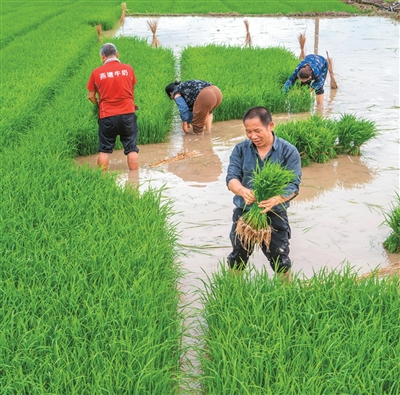
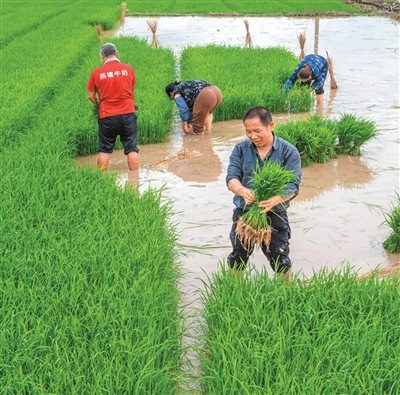
On July 5, farmers were planting late rice seedlings in Heyetang Village, Zixi Town, Dong'an County, Yongzhou City, Hunan Province.Photo by Cai Xiaoping (People's Vision)
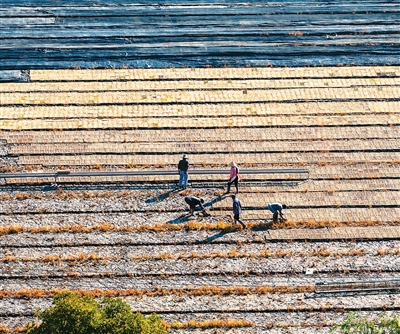
On July 3, farmers in Shangtang Village, Huangjiabu, Yuyao City, Zhejiang Province placed seedling trays for continuous cropping late rice in the field.Photo by Zhang Hui (People’s Vision)
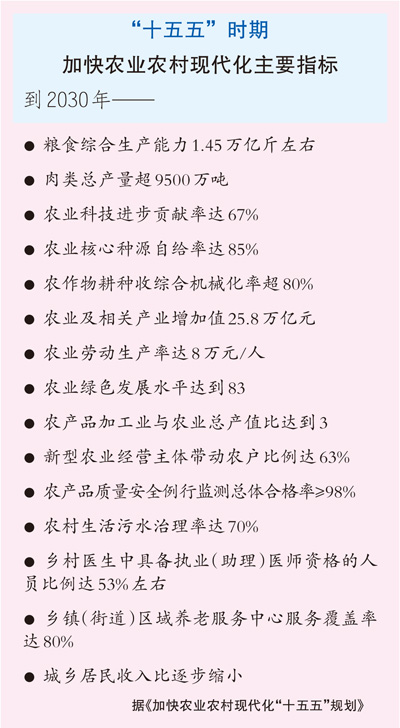
By 2030, the comprehensive grain production capacity will reach about 1.45 trillion kilograms - in the "15th Five-Year Plan to Accelerate Agricultural and Rural Modernization" (hereinafter referred to as the "Plan"), grain production capacity is proposed as the first major indicator and one of the only two binding indicators.
From 1.39 trillion catties to about 1.45 trillion catties, this means that China’s comprehensive grain production capacity must increase by about 60 billion catties in the next five years.Why set this "hard leverage" as the primary goal?What impact will achieving this goal have on the jobs of more than 1.4 billion people?
StableMake food security more powerful
——China’s per capita grain possession is 509 kilograms, far exceeding the internationally recognized food security line of 400 kilograms; in the next five years, grain production capacity will increase by about 12 billion kilograms annually
Recently, a piece of news has caused concern around the world: the Food and Agriculture Organization of the United Nations recently warned that extreme weather caused by a new round of El Niño phenomena may have a serious impact on millions of people around the world who rely on agricultural production, and trigger food crises in some areas.The Washington Post and other foreign media published articles stating that the El Niño phenomenon, combined with the war between the United States and Israel, threatens global food security.
Tu Shengwei, a researcher at the Macroeconomic Research Institute of the National Development and Reform Commission, told our reporter that in recent years, due to the increase in various extreme weather events, the complex and volatile international situation, and the increasing uncertainty in the international grain market, food security has become a common challenge faced by all countries.
How to deal with challenges?Stable comprehensive grain production capacity is the key answer.
As an important indicator reflecting the country's food security capabilities, comprehensive grain production capabilities include the ability to withstand natural disasters, as well as cultivated land protection capabilities, production technology levels, policy support capabilities, etc., and are the basis of grain output.
Tu Shengwei believes that setting a target of about 1.45 trillion jin is to respond to environmental uncertainty with the stability of production capacity, provide more space for macro-control, and effectively resist various risk impacts.
From the perspective of domestic development, China's comprehensive grain production capacity has successively reached new levels of 1.2 trillion catties and 1.3 trillion catties, reaching 1.39 trillion catties by 2025, after increasing production for many years in the early stage and starting from a high starting point.Based on this production capacity, China's grain output reached 1.32 trillion catties in 2015, and has remained stable at more than 1.3 trillion catties for nine consecutive years since then.In 2024, my country's grain output will exceed the 1.4 trillion catties mark and reach 1.43 trillion catties in 2025, an increase of 90.8 billion catties or 6.8% over 2020. Food security is effectively guaranteed.
From an international comparison, relying on stable comprehensive grain production capacity, China has become the world's largest grain producer. For every 5 kilograms of grain in the world, more than 1 kilogram of grain is produced in China; per capita grain possession will increase from 483 kilograms in 2021 to 509 kilograms in 2025, far exceeding the internationally recognized food safety line of 400 kilograms.
How to further enhance the comprehensive grain production capacity? How to achieve the goal?What can you bring?
"The goal of about 1.45 trillion jin is based on the foundation of my country's grain production capacity construction during the '14th Five-Year Plan' period, with conditions and support." Tu Shengwei said that in recent years, by continuously strengthening agricultural infrastructure construction and strengthening agricultural science and technology and equipment support, my country's agricultural production infrastructure, machinery and equipment, and technical conditions have been significantly improved compared with the past, laying a solid foundation for further increasing production capacity.According to the target, grain production capacity needs to increase by about 12 billion jin per year in the next five years.Overall, there are conditions to achieve the 2030 production capacity target by intensifying the implementation of a new round of grain production capacity improvement actions of 100 billion kilograms, promoting large-area yield increases of major crops such as grains and oils, and promoting the integration and efficiency of good fields, seeds, opportunities, and methods."For the common people, the further increase in grain production capacity can make us more secure in terms of 'eating full' and 'eating well'. At the same time, grain prices are the basis of hundred prices. Abundant production capacity can help stabilize food price fluctuations and protect people's 'rice bags' and 'vegetable baskets.'"
Change from output-led to equal emphasis on output and quality
——Stabilize the production of rice and wheat, increase the production capacity of corn and soybeans; increase the supply of high-quality edible rice, special wheat with strong and weak gluten, and high-yield and high-oil soybeans
The comprehensive grain production capacity will increase by about 60 billion kilograms, which is not only a change in quantity.This "Plan" clearly proposes a change: to promote the transformation of agriculture from output-dominated to equal emphasis on output and quality.
“Around 1.45 trillion jin is a new target for grain production capacity, which inherently contains requirements for both yield and quality.” Tu Shengwei said that the changes proposed in the “Plan” clearly convey the policy orientation of my country’s agricultural development in the future, which is to scientifically coordinate the relationship between total supply and quality improvement, and promote balanced and coordinated development.
What to transfer specifically?
Let’s look at rice and wheat first.As my country's two major rations, rice and wheat play an irreplaceable role in people's rice bowls.Among them, rice is the largest staple food, with more than 60% of the country's population relying on rice as the staple food, and wheat is the second largest staple food. The annual output of the two is close to 700 billion kilograms, accounting for nearly half of the total annual grain output.Data recently released by the National Bureau of Statistics show that in 2025, the self-sufficiency rate in grains and rations will be above 95% and 100% respectively.
"Currently, my country's rice and wheat production is absolutely guaranteed and stocks are sufficient, but there is a structural shortage." Tu Shengwei said, especially the production capacity of high-quality edible rice and special wheat with strong and weak gluten is insufficient. In this regard, the "Plan" clearly needs to increase related supplies.Next, we should start from various aspects such as variety, technology, market, etc., expand the planting scale of high-quality edible rice and special wheat with strong and weak gluten according to local conditions, promote the integration of good fields, good seeds, good opportunities and good methods to increase efficiency, and improve the high-quality and high-price mechanism so that high-quality grain products can be sold well.
Look at corn and soybeans.The "Plan" proposes to increase the production capacity of corn and soybeans and increase the supply of high-yield and high-oil soybeans.
Tu Shengwei believes that the reason why the increase in grain production capacity is focused on corn and soybeans is, on the one hand, taking into account the changing trends in my country's grain consumption demand.In terms of grain consumption, ration consumption is declining, and future growth in grain demand will mainly come from the growth of feed grains such as corn and soybeans.On the other hand, the production potential of corn and soybeans is also taken into consideration.my country's corn and soybean yields are still far behind the international advanced level, and there is huge potential for increasing yields.
"Among them, soybeans are an agricultural product with a prominent contradiction between supply and demand in my country, and are also the top priority for increasing grain production capacity. One of the main directions is to increase the supply of high-yield and high-oil soybeans." Tu Shengwei said that promoting the use of high-yield and high-oil soybean varieties will not only help improve my country's soybean oil yield per unit area, increase domestic supply capacity, and reduce dependence on imports, but also help the grain and oil processing industry improve quality and efficiency, and increase the added value of products.In the next step, we should further promote the "Ten Hundreds and Thousands" campaign of high-oil and high-yielding soybeans, intensify efforts to promote high-oil and high-protein soybean varieties, and continue to optimize the variety structure.
Strengthen: Implement the strictest farmland protection system
——By the end of 2025, more than 1 billion acres of high-standard farmland will have been built across the country.The "15th Five-Year Plan" will strengthen the connection between high-standard farmland canal systems and backbone projects in irrigation areas, and implement a new round of black soil protection projects
What can we rely on to improve comprehensive grain production capabilities?"Hiding food in the land and hiding food in technology" is a strategy that must be implemented in depth.The "Plan" proposes to strengthen the protection and quality improvement of cultivated land.
In recent years, various regions and departments have achieved certain results in protecting cultivated land, but destruction of cultivated land and illegal occupation of agricultural land still occur.On June 22, the Supreme People's Procuratorate released a number of typical cases on judicial protection of land resources.
The reporter found that in these cases, some people illegally dumped construction waste such as trench soil and shield mud into permanent basic farmland and other cultivated land, causing the destruction of agricultural land; some brick factories occupied agricultural land such as paddy fields and orchards and built illegal buildings.
“Cultivated land is the lifeblood of food production and the foundation on which we depend for food.” Tu Shengwei said that in the next five years, the most stringent cultivated land protection system must be implemented, the overall layout of agricultural land should be optimized, strict management of the balance between occupation and compensation, and standardization of the quality acceptance of supplementary cultivated land.At the same time, efforts must be made to promote the construction of high-standard farmland, improve farmland water conservancy facilities, and continue to consolidate the foundation of grain production.
According to data released by the National Bureau of Statistics, as of the end of 2025, more than 1 billion acres of high-standard farmland have been built nationwide, and the national irrigated cultivated land area has exceeded 1.09 billion acres, an increase of more than 53 million acres from the end of 2020.By the end of 2024, more than 27 million small-scale farmland water conservancy facilities and more than 10 million kilometers of water canals have been built across the country.
“The construction of high-standard farmland is a basic project to ensure food security. According to relevant arrangements, we will strive to build a total of 1.35 billion acres of high-standard farmland by 2030, and strive to build all qualified permanent basic farmland into high-standard farmland by 2035.Quasi-farmland." Tu Shengwei said that at present, high-standard farmland construction still has problems such as reconstruction and light management. In this regard, we should strengthen the emphasis on both new construction and renovation, both quantity and quality, and construction and management and maintenance, and connect all aspects of construction, acceptance, management and maintenance, especially management and maintenance issues.At present, some high-standard farmland has no one to take care of it after it is built, and there is no money to manage it. In the end, it cannot achieve the effect.We should strengthen the construction of operation, management and protection mechanisms, promote the realization of "managed", "managed with money" and "managed well", and truly build qualified cultivated land, especially permanent basic farmland, into modern fertile farmland suitable for farming, guaranteed to yield during droughts and floods, and with high and stable yields.
The "Plan" also proposes to strengthen the modernization and transformation of large and medium-sized irrigation areas, and strengthen the connection between high-standard farmland canal systems and backbone projects in irrigation areas.We will implement a new round of black soil protection projects to increase the organic matter content of cultivated land, strengthen the management of acidified cultivated land, and steadily promote the comprehensive utilization of saline-alkali lands.Tu Shengwei believes that farmland protection and quality improvement is a systematic project that requires multiple measures and coordinated efforts."Only by cherishing every inch of land and making good use of every inch of land can our jobs be stable and secure."(Reporter Qiu Haifeng)